

By Erez Nudmanov · Photographer and Author · September 2026
Why website structure, useful content and trust matter alongside the portfolio
A photography website once had a straightforward role: present a strong portfolio and make it easy for potential clients or followers to contact the photographer. That role still matters, but it no longer covers the full way people discover photography online. Visitors now search with detailed questions, use answer engines for quick guidance and ask generative AI systems to compare locations, techniques and photographers. A gallery can inspire them, yet photographs alone rarely provide enough context to answer those questions.
A modern photography website therefore needs two qualities. It must remain visually convincing, and it must explain the knowledge behind the work. When images, experience, structure and trustworthy information support one another, the site becomes easier for people to use and easier for search and AI systems to understand. The following five principles summarize the central method presented in my book Building Photography Websites for the Age of AI.
Photography Discovery Has Changed
Traditional search usually began with a short query and a page of links. The user opened several results, compared them and assembled an answer. That journey is becoming more conversational. A photographer might now ask for the best season to photograph the Dead Sea, the safest access to a location, suitable lenses and likely weather conditions in one request. Search engines may still provide links, while answer engines and generative systems may summarize information before the user visits a website.
This change does not make the photographer’s website less important. It changes what the website must contribute. Discovery systems need accessible pages that explain subjects, relationships and real-world experience. A portfolio shows the result, but a useful article can explain the planning, conditions, choices and mistakes behind that result. The image attracts attention; the surrounding knowledge gives the page meaning and makes it useful beyond the existing audience.

A traditional portfolio website compared with a modern photography website that combines images with practical knowledge.
SEO, AEO and GEO Serve Different Discovery Journeys
SEO, or Search Engine Optimization, helps search engines discover, index and understand a page so they can match it to a relevant search. For a photography website, that includes clear page titles, descriptive headings, meaningful URLs, crawlable internal links, useful text and properly prepared images. SEO is not simply the repetition of keywords. Its practical purpose is to remove ambiguity and help the right visitor find the right page.
AEO, or Answer Engine Optimization, focuses on questions that may be answered directly in search results, voice assistants or other answer interfaces. A well-structured page supports this by stating the question clearly, giving a concise and accurate answer, and then supplying the detail a reader needs to verify or apply it. FAQs can help when they reflect genuine visitor questions, but AEO is mainly the result of clear writing and logical organization.
GEO, or Generative Engine Optimization, describes efforts to improve visibility in AI-generated answers and recommendations. Generative systems benefit from content that contains context, firsthand experience, clear authorship and information that can be checked. GEO does not offer a guaranteed formula for being cited. Google’s current guidance also makes an important point: from its perspective, optimization for generative AI search remains part of SEO. The same strong foundation serves all three journeys. One website should provide useful information for people, search engines, answer engines and generative systems rather than creating separate versions for each.

One photography knowledge platform can support SEO, AEO and GEO simultaneously.
A Strong Website Is a Connected Knowledge System
Good content is difficult to discover when the website around it is disorganized. Information architecture defines how pages are grouped, named and connected. A clear structure might separate portfolios, photography insights and destination guides while linking them where the visitor’s next question naturally leads. Categories establish the main subjects. Tags add limited contextual connections. Descriptive URLs and navigation labels make the hierarchy visible.
Pillar pages and topic clusters create depth. A broad guide to landscape photography can introduce composition, planning, light, filters, camera settings and post-processing. Focused supporting articles can then explain each subject properly and link back to the main guide. Internal links show readers where to continue and help discovery systems understand which pages belong to the same area of expertise.
This is also how topical authority develops. One article may answer one question well, but a connected group of accurate, experience-based pages demonstrates sustained knowledge of the subject. The aim is to cover the topic as a photographer understands and practices it, not to manufacture a page for every keyword variation.
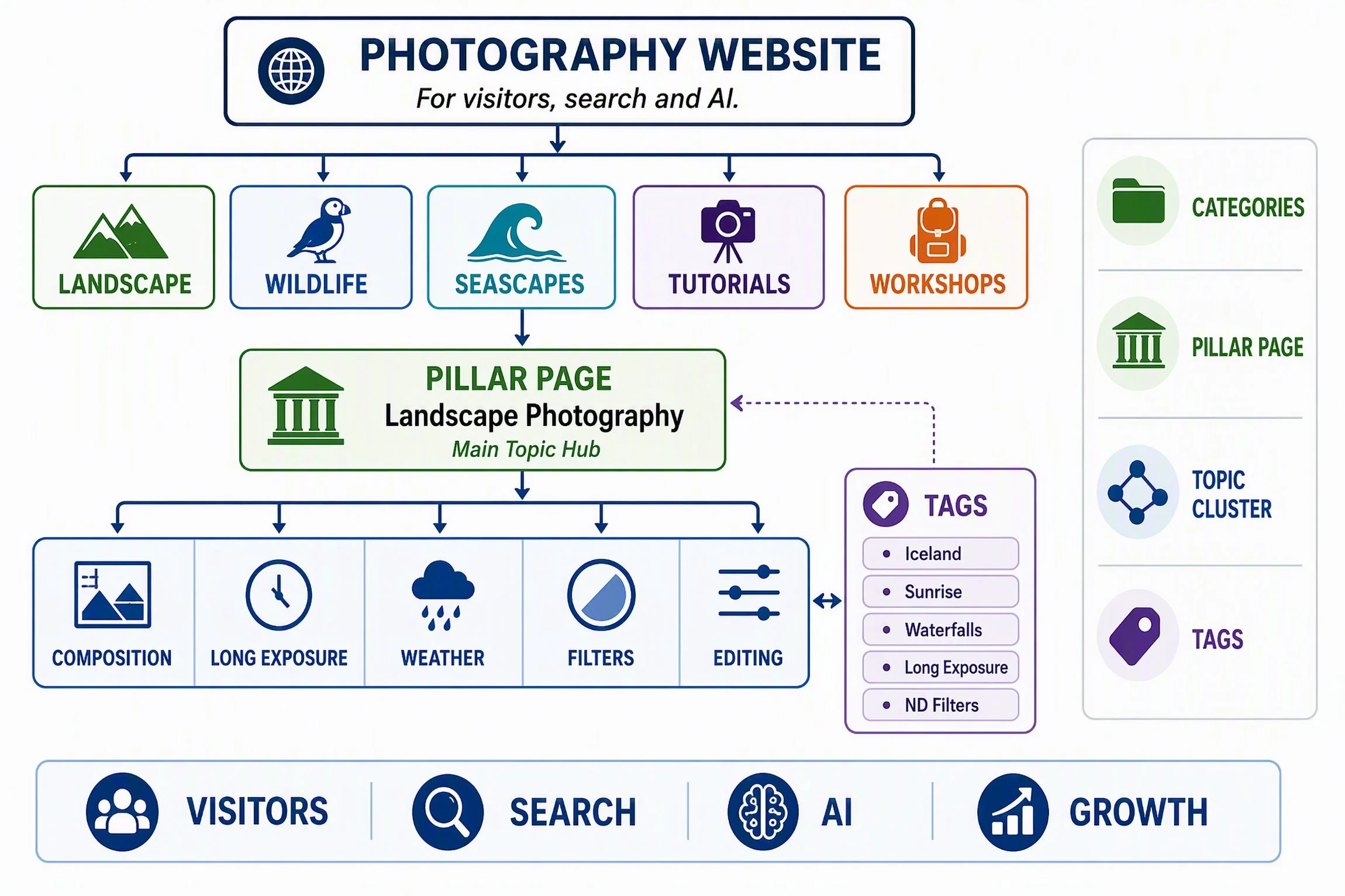
A well-structured photography website connects categories, pillar pages, supporting articles and related content.
Experience Turns Photography into Authoritative Content
Photographers already possess the raw material for original content. Every field trip includes decisions about timing, access, weather, focal length, exposure, composition and editing. A destination guide can explain where and when to work. A behind-the-image article can show why one composition succeeded. A tutorial can use an actual photograph to demonstrate a technique. Even a failed attempt can reveal what should be changed next time.
This kind of content is more valuable than generic summaries because it comes from direct experience. It should be written for the reader first, using a clear heading hierarchy, focused sections and relevant photographs or diagrams. Each article should answer a defined question and provide enough detail to be useful without forcing the reader through unnecessary text.
The photographs must also function as information. File names, captions and alternative text should describe what the image contributes. Captions can explain a setting, condition or decision that the picture alone cannot communicate. On a photography website, high-quality images and precise text support each other; neither should be treated as decoration for the other.

A useful educational article combines clear instruction, a real photographic example and practical takeaways.
Trust and Improvement Create Long-Term Visibility
Useful content must also be credible. E-E-A-T refers to Experience, Expertise, Authoritativeness and Trustworthiness. It is a practical framework for evaluating the credibility of online content, not a checklist that guarantees rankings. For photographers, experience appears through original images, field observations and explanations of real decisions. Expertise appears in accurate, specific guidance. Authority grows when a consistent body of work is recognized and referenced. Trust depends on clear authorship, transparency, reliable sources and content that remains accurate.
An author biography should explain who created the material and why that person has relevant experience. Facts that depend on external information, such as access rules, safety restrictions, technical specifications or opening hours, should be supported by reliable sources and reviewed when conditions change. Personal judgment should be presented as judgment rather than as a universal fact. This distinction strengthens the reader’s confidence and gives discovery systems clearer signals about the source.
A website is never finished after publication. Performance should be measured through more than rankings or total traffic. Search visibility matters, but so do qualified visitors, reading depth, movement to related pages, return visits, enquiries and other meaningful actions. Regular reviews should identify outdated facts, weak internal links, slow images and pages that no longer serve their purpose. Continuous improvement protects both usefulness and trust.

Firsthand experience and reliable references work together to create trustworthy photography content.
Frequently Asked Questions
What is the difference between SEO, AEO and GEO?
SEO helps search engines discover and rank useful pages. AEO helps content provide clear answers to specific questions. GEO focuses on making reliable, well-structured content understandable and usable by generative AI systems.
Is a photography portfolio enough for online visibility?
A strong portfolio remains essential, but images alone provide limited context. Articles, destination guides and behind-the-image explanations help visitors and discovery systems understand the photographer’s knowledge, experience and areas of expertise.
How can a photographer demonstrate E-E-A-T?
Use original photographs, firsthand field observations, accurate technical explanations, clear authorship and reliable external references. Personal experience should be distinguished from facts that depend on official or frequently changing information.
Explore the Complete Guide

This article summarizes key principles from my book, Building Photography Websites for the Age of AI: A Practical Guide to SEO, AEO, GEO and AI Discovery. The complete guide explains how photographers can transform a portfolio website into a structured, trustworthy and discoverable knowledge platform
